magnet magnetism

/Tag:magnet magnetism
  • Linear Motor Magnetic Assembly Guide

Linear Motor Magnetic Assembly Guide

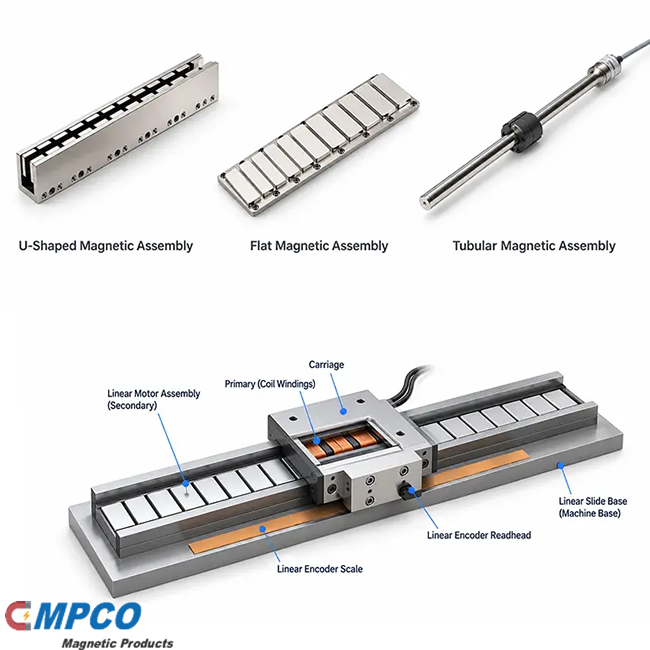
Linear Motor Magnetic Assembly Guide A Linear Motor Magnetic Assembly is an important magnetic component in a permanent magnet linear motor. It usually consists of multiple NdFeB magnets arranged according to a specific magnetic pole arrangement, pole pitch, and magnetization direction. The magnets are assembled with a steel back iron, yoke, or other support structures [...]

  • What is Eddy Current Losses in Permanent Magnet Materials

What is Eddy Current Losses in Permanent Magnet Materials?

What is Eddy Current Losses in Permanent Magnet Materials? Understanding and Minimizing Eddy Current Losses in SmCo and NdFeB Magnets Eddy current losses are a significant concern in rotating machinery, especially when using metal-based permanent magnets like Samarium-Cobalt (SmCo) and Neodymium-Iron-Boron (NdFeB). Core losses, which include both eddy current losses and hysteresis losses, must be [...]

  • How to Make Magnetic Slime

How to Make Magnetic Slime

How to Make Magnetic Slime Put a twist on the classic slime science project by making magnetic slime. This is slime that reacts to a strong magnetic field, like a ferrofluid, but it's easier to control. It's easy to make, too. Here is what you do: Magnetic Slime Materials white school glue (e.g., Elmer's glue) [...]

  • How to Make Liquid Magnets

How to Make Liquid Magnets

How to Make Liquid Magnets A liquid magnet, or ferrofluid, is a colloidal mixture of magnetic particles (~10 nm in diameter) in a liquid carrier. When no external magnetic field is present, the fluid is not magnetic and the orientation of the magnetite particles is random. However, when an external magnetic field is applied, the [...]

  • The Science of Magnetic Field Lines

The Science of Magnetic Field Lines

The Science of Magnetic Field Lines A magnetic field surrounds any electric charge in motion. The magnetic field is continuous and invisible, but its strength and orientation may be represented by magnetic field lines. Ideally, magnetic field lines or magnetic flux lines show the strength and orientation of a magnetic field. The representation is useful [...]

  • Magnetizing Steel without Special Tools

Magnetizing Steel without Special Tools

Magnetizing Steel without Special Tools Step 1 Find north. Find north. If you have a compass, the needle will point directly to magnetic north. Otherwise finding true north should be good enough for this method. Step 2 Arrange the steel so it points north. Arrange the steel so it points north. Put the steel object [...]

By |June 29th, 2024|Learning Resources, Magnetic Field, Magnetic Ideas, Magnetic Knowledge, Magnetic News, Magnetic Science, MPCO Magnetics News, NdFeB, Neodymium Magnets, Permanent Magnet|Comments Off on Magnetizing Steel without Special Tools
  • Magnetize Steel Using a Battery

Magnetize Steel Using a Battery

Magnetize Steel Using a Battery Strip the insulation off both ends of a wire. Using wire stripping pliers, strip about 1 in (2.5 cm) of insulation from each end of an insulated wire. You'll need enough wire to wrap around your steel object at least 10 times. "Enameled wire" with thin insulation will have a [...]

  • Magnetizing Steel Using an Existing Magnet

Magnetizing Steel Using an Existing Magnet

Magnetizing Steel Using an Existing Magnet Use this to quickly make a temporary magnet. Keep a strong magnet around, and you can magnetize some types of steel with a couple minutes of work. This turns the steel into a weak magnet that loses its magnetism over time. This method is ideal for magnetizing a screwdriver, [...]

By |June 25th, 2024|Learning Resources, Magnetic Field, Magnetic Ideas, Magnetic Knowledge, Magnetic News, Magnetic Science, MPCO Magnetics News, NdFeB, Neodymium Magnets, Permanent Magnet|Comments Off on Magnetizing Steel Using an Existing Magnet
  • Making an Electromagnet

Making an Electromagnet

Making an Electromagnet Gather the necessary materials. To make an electromagnet, you will need insulated copper wire, a piece of metal with known iron content, a 12-volt battery (or other DC power supply), wire strippers/cutters, and electrical tape. The insulated copper wire needs to be thin enough to easily wrap around the metal and long [...]

  • Magnetize a Metal Using Striking Hammer

Magnetize a Metal Using Striking Hammer

Magnetize a Metal Using Striking Hammer Gather the necessary materials. To magnetize a metal using a hammer, you will need a compass, a hammer, and a piece of metal with some iron. These items can easily be purchased at a local hardware store. A metal alloy that doesn’t have iron in it is less likely [...]

By |June 21st, 2024|Learning Resources, Magnetic Field, Magnetic Ideas, Magnetic Knowledge, Magnetic News, Magnetic Science, MPCO Magnetics News, NdFeB, Neodymium Magnets, Permanent Magnet|Comments Off on Magnetize a Metal Using Striking Hammer
  • Rubbing the Metal with a Strong Magnet

Rubbing the Metal with a Strong Magnet

Rubbing the Metal with a Strong Magnet Gather the necessary materials. To magnetize metal with this method, you just need a strong magnet and a piece of metal with known iron content. Metals without iron will not become magnetic. A strong magnet, such as neodymium, can easily be purchased online. Identify the North pole of [...]

By |June 19th, 2024|Learning Resources, Magnetic Field, Magnetic Ideas, Magnetic Knowledge, Magnetic News, Magnetic Science, MPCO Magnetics News, NdFeB, Neodymium Magnets, Permanent Magnet|Comments Off on Rubbing the Metal with a Strong Magnet
  • Magnetic attraction Of disc rod magnet

Can NdFeB Absorb Objects 600 Times Its Own Weight? Not Exactly

Can NdFeB Absorb Objects 600 Times Its Own Weight? Not Exactly Magnets can pick up heavy objects. It is said on the Internet that NdFeB magnets can pick up objects 600 times their own weight. Is this accurate? Is there a formula for calculating magnet attraction? Today, I will tell you about the "attractive force" [...]

error: Content is protected !!