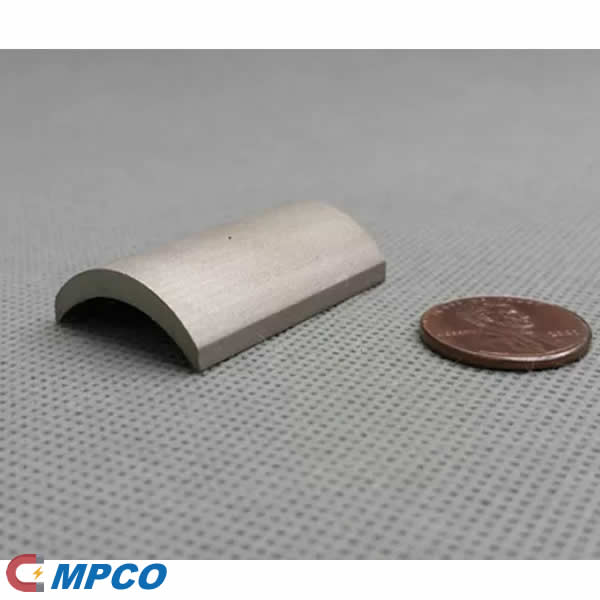
AC Motor SmCo Tile Permanent Magnet YX-28, Asynchronous Induction Motor SmCo Rare Earth Segment Sector Military Magnets, High Work Temp Permanent Motor Generator Rotor SmCo Magnet for PMDC Motor wind turbine, Super strong curved tile arc segment magnets China Supplier
AC Motor SmCo Tile Permanent Magnet YX-28 Item No. MPCO-SMOS series Customzied Specific Requirements OEM or ODM service: Accept Dimension: Customized size Custom Grade: SmCo5, Sm2Co17 Magnetization direction: Thickness, Length, Axially, Diametre, Radially, Multipolar Surface Treatment: UNCOATED, Silver, Gold, Zinc, Ni-cu-Ni. Epoxy etc. Tolerance: +/-0.02 – 0.05mm
Samarium Cobalt (SmCo) magnets, of the Rare Earth class, have been available since the early 1970’s. These magnets possess very high magnetic properties, excellent thermal stability, while remaining resistant to corrosion. These characteristics make SmCo magnets ideal for applications requiring a resistance to wide-ranging temperatures and environments.
SmCo magnets are manufactured by sintering or compression bonding. They are anisotropic and can only be magnetized in the direction of orientation. In general, magnetizing fields of approximately 30 to 45KOe are required to saturate SmCo magnets.
Motors within the AC motor classification are either synchronous or asynchronous, primarily distinguished by the speed of the rotor relative to the speed of the stator. The speed of the rotor relative to the stator is equal in a synchronous motor, but the rotor speed is less than its synchronous speed in an asynchronous motor. In addition, synchronous motors have a zero slip and require an additional power source, while asynchronous or induction motors do have slip and do not require a secondary power source.
Generator Rotor SmCo Magnet for Permanent Magnet AC Motors
A synchronous motor is a doubly excited machine, meaning it includes two electrical inputs. In a common three-phase synchronous motor, one input, usually three-phase AC, supplies the stator winding to produce three-phase, rotating magnetic flux. The rotor supply is usually DC, which excites or starts the rotor. Once the rotor field locks with the stator field, the motor becomes synchronous. Industrial PMDC Motor Arc SmCo Magnet
Application for High Temperature Strong Permanet SmCo Magnet : Motors, watch, transducers, instruments, positional detector, generators, radar communications, medical equipments, various magnetism spreading devices, magnetic processor, electrical engineering and magnetic derrick, etc. Industrial Motor Solenoid Magnet SmCo Segment
PMDC Motors (Permanent Magnet). The most common type of brushed electric motor, PMDC motors use permanent magnets to produce the stator field. Characteristics: used in commercial production of toys and appliances, cheaper to manufacture, good low end torque, limited high end torque.
Synchronous AC Motor Arc SmCo Magnet
Specific requirements : 1. The properties of the grade is maintain strictly. 2. Hk/Hcj should be not less 0,55. 3. Couple magnetized 50%N(S) and 50%S(N). 4. The poles must be marked. 5. The magnetic pole N marked with blue paint. 6. The magnetic pole S marked with red paint. Note: poles must be magnetic, not geographical. 7. The thickness of the magnet will be monitored 4,35 – 4,50 mm. 8. Induction on a convex surface “B out” should be more 170 mT (163 mT old value). 9. Induction on the concave surface “B int” should be more 60 mT. 10. Variation in the magnetic flux for whole order must not exceed 15% or that is the same max(F)/min(F) ≤1,15. 11. The fall of the magnetic flux F2 at + 20 gr. C, after heating to + 200 gr. C during one hour, is not more than 3% or that is the same F2/F1≥0.97. Tile Permanent SmCo Magnet for Induction Motors
16mm x 2mm Dic NdFeB Toy Magnet N42 Ni, Super Strong Rare Earth Sintered NdFeB Disk Magnet for Toy and Craft, NiCuNi Coated Neodymium Disc Permanent Magnets China Exporter 16mm x 2mm Dic NdFeB Toy Magnet N42 NiTechnical Specifications: Item: NDN42-1602 Grade: N42 Material: Neodymium (NdFeB) Plating: Ni Shape: Disc, Disk, Round Dimension: Total Diameter (D): […]