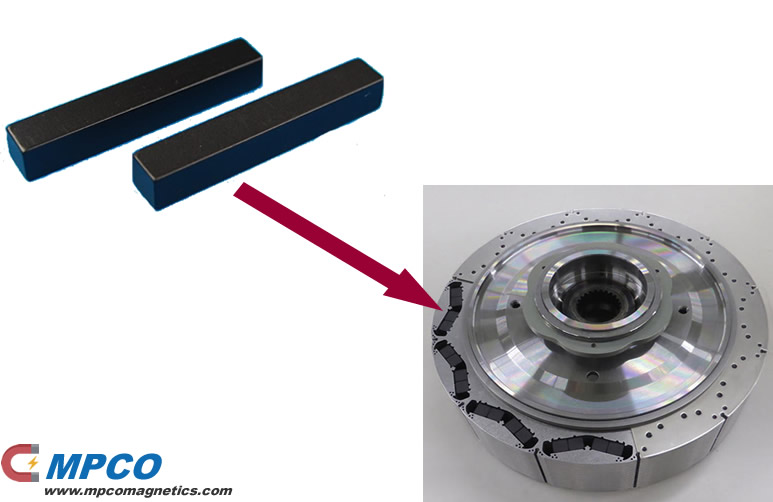
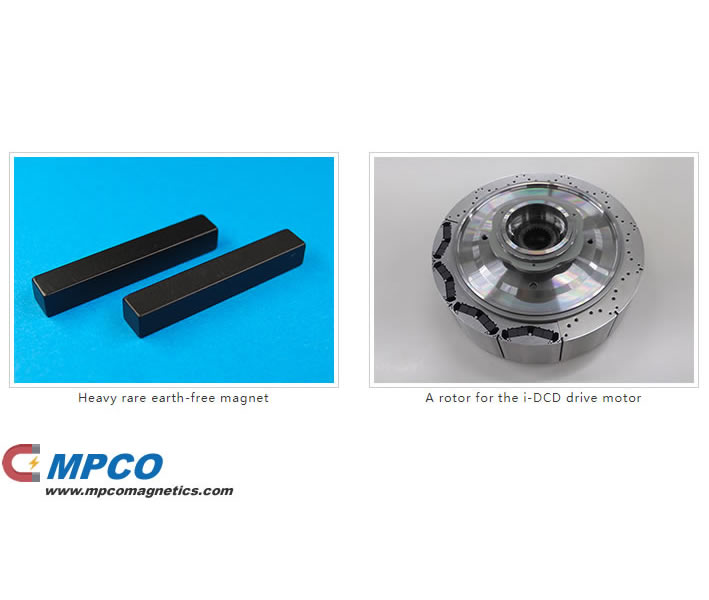
Block Neodymium Hybrid Vehicle Motor Magnets for Honda FREED, Heavy rare earth-free magnet, i-DCD drive motor rotor Neodymium magnets, block permanent magnets for drive motors of electric and hybrid vehicles
Block Neodymium Hybrid Vehicle Motor Magnets for Honda FREED feature:
Magnetic Grade NO. N52, N45SH, N48H, N38EH
Composition Neodymium Iron Boron Magnets
Content (Percent) 33% ND, 66% Fe, 1% B
Processing Technical Sintered Magnets
Size Custom
Coting Black Epoxy
Shape Block
Tolerance +/-0.1 mm
Work Temperature 80-230 Degree Celsius
Delivery Date 7-15 Days After Order Confirmed
Means of Transport by Air or by Ocean
Trademark MPCO
Transport Package Standard Export Carton
Specification ISO9001: 2008, SGS, ROHS
Origin Zhejiang Ningbo
HS Code 85051110
New neodymium magnet in hybrid vehicles
This method of neodymium magnet production enables nanometer-scale crystal grains to be aligned to realize a fine crystal grain structure that is approximately ten times smaller than that of a sintered magnet, which makes it possible to produce magnets with greater heat resistance properties.
Honda revised the shape of the magnet to make it fit in the drive motor of its hybrid vehicles while also redesigning the motor and the shape of the rotor to optimize the flow of the magnetic flux of the magnet.
The result is a hot deformed neodymium magnet with no heavy rare earth metal that provides torque and with heat resistance performance similar to a conventional magnet.
Honda will use the new hot deformed neodymium magnet on the Honda SPORT HYBRID i-DCD 2 system for the all-new FREED.
Neodymium magnets have the highest magnetic force among all magnets in the world and are being used for the drive motors of electric vehicles including hybrid vehicles, and therefore demand for neodymium magnets are expected to grow exponentially in the future.
For use in the drive motors of electric vehicles, neodymium magnets must have high heat resistance properties as they are used in a high temperature environment. Adding heavy rare earth (dysprosium and/or terbium) to the neodymium magnets has been a conventional method to secure such high heat resistance.
However, major deposits of heavy rare earth elements are unevenly around the world, and also are categorized as rare metals; thus, the use of heavy rare earth carries risks from the perspectives of stable procurement and material costs. Therefore, a reduction in the use of heavy rare earth elements has been one of the major challenges needing to be addressed in order to use neodymium magnets for the drive motors of hybrid vehicles. neodymium motor magnets
Related