Circumferentially Oriented Magnets in Hysteresis Coupling, circumferential direction ring Alnico magnets for hysteresis systems
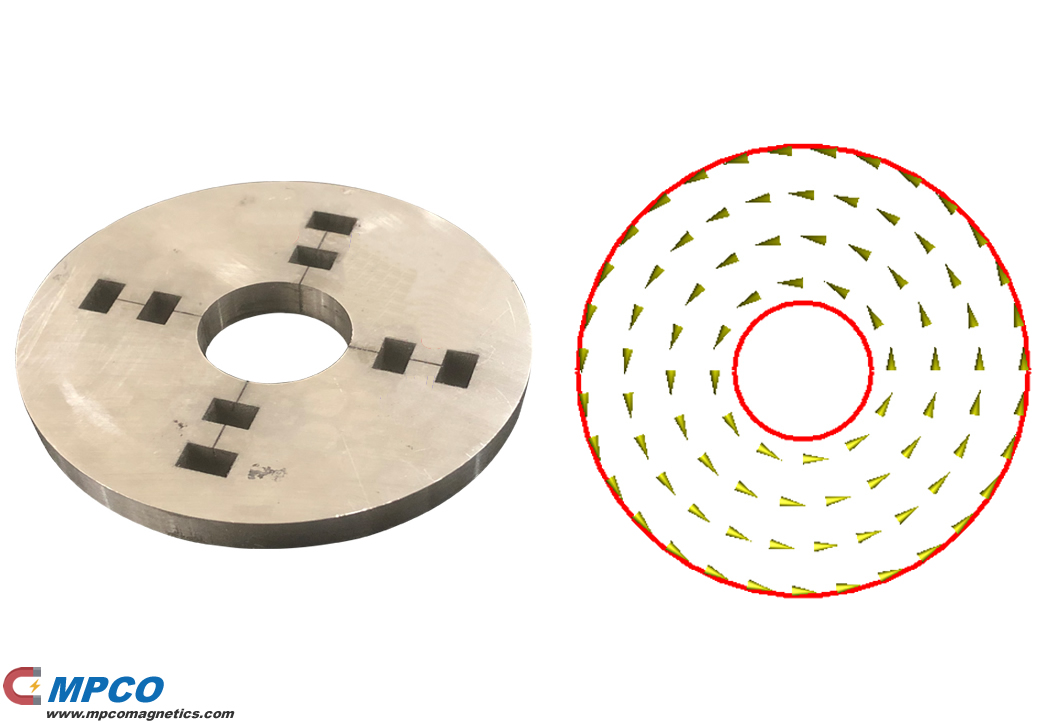
Circumferentially Oriented Magnets in Hysteresis Coupling – In theory, closed circuit means the magnet does not have any exposed poles and will not generate the external magnetic field, then applies no useful application. But in reality, circumferentially oriented magnets can be served to hysteresis coupling as hysteresis part. Hysteresis coupling utilize multi-pole magnetized permanent magnet faces a disc of a non-magnetized hysteresis material which has high residual induction and low coercivity. The permanent magnet with certain arrangement force portions of the hysteresis material to cycle along its minor hysteresis loop. The magnetic material will operate on a minor hysteresis loop when it does not reach saturation, and minor hysteresis loop requires less energy for moving magnet around them which is the basis for hysteresis systems. The turning and braking toque of hysteresis coupling is extremely depends on the dimension, magnetic material, pole number and air gap as below shown, and independent of the relative speed and is fully available even at very low relative speed.
Circumferentially orientation and magnetizing pattern is not available for arc and ring magnets which comprised of Neodymium magnets and Samarium Cobalt magnets. The most common circumferentially oriented magnets are common Alnico horseshoe magnet, however, whether or not Alnico ring magnets can be oriented and magnetized through circumferential direction? In fact, Alnico ring magnets can achieve circumferentially orientation by using magnetic field generated by electrified straight conductor.
In general high orientation facilitates scientific investigation and can open up new technological applications by improving physical or biological properties. Electric and magnetic fields can induce orientation. However, the former can cause potentially harmful heating effects when the medium is conducting, which is generally the case with biological samples, whilst there is no evidence to suggest that the application of a strong magnetic field can cause significant chemical damage. As the magnetic field acts at a distance its effect permeates the entire sample; consequently uniform orientation can be attained in bulk samples. GBD Process NdFeB Magnets
This paper describes a method of producing circumferentially oriented magnetic hard composites (bonded magnets). This means that the directions of easy magnetization of the magnetically hard particles contained in the magnet are perpendicular to the radius and to the axis of the cylindrical sample (parallel to the direction tangential to the surface of the cylinder). Tests were carried out on two magnetically hard materials (Nd-Fe-B and barium ferrite) with two different volumes of the solid phase in the slurry. The bonded magnets were produced by the centrifugal casting of the slurry in a constant magnetic field. The obtained shapes, in the form of cylinders, possessed a well compacted hard magnetic layer, with a thickness depending on the powder content in the slurry. In all cases, the remanence of the obtained samples was the highest in the circumferential direction, i.e. perpendicular to the longitudinal section of the cylinder. X-ray investigations revealed that the samples obtained have a crystallographic texture. A model of phenomena occurring during centrifugal casting of slurry in a magnetic field was proposed, which explains the structure of the obtained materials is shaped.
Related