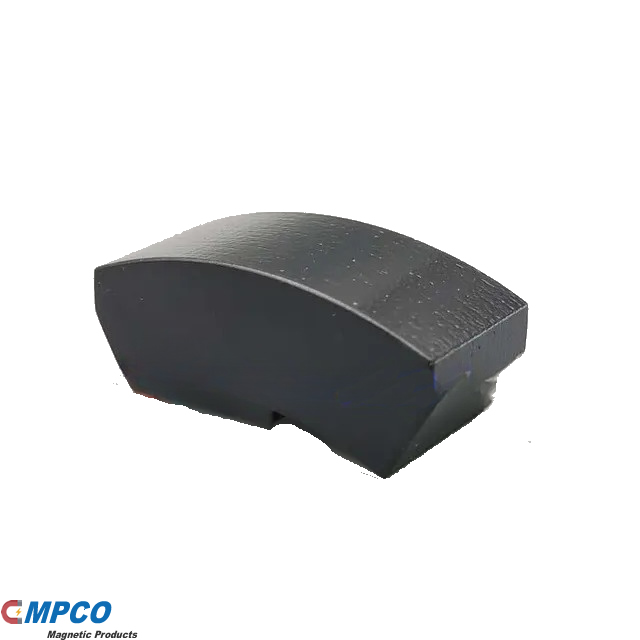
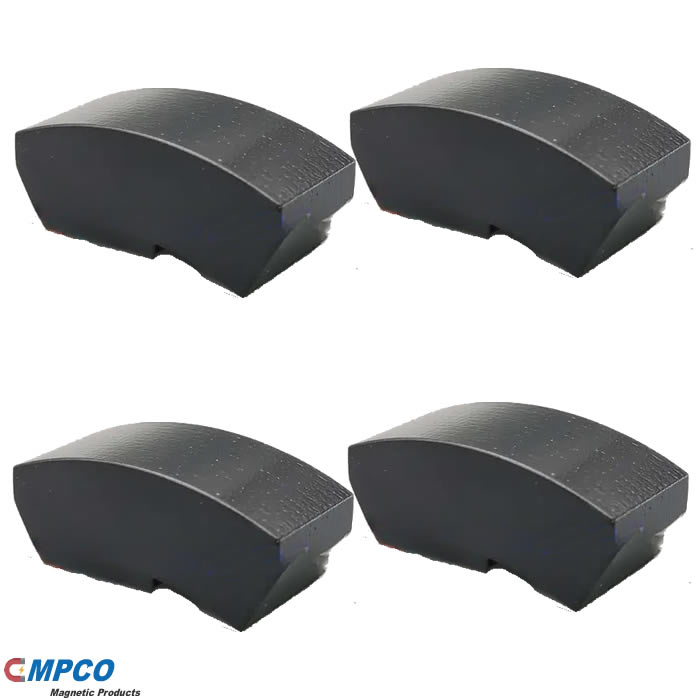
Epoxy Painted NdFeB Segmentation Magnet N40UH for Special Motors, Block Laminated Magnet with Groove and Epoxy, Arc Tile Segment Permanent NdFeB Lamination Motor Magnet, Super Strong Block Laminated Motor Magnets for Eddy Current Loss, Laminated Glued Layered Square Neodymium Magnets, Magnet Segmentation Technology
Epoxy Painted NdFeB Segmentation Magnet N40UH for Special Motors Item No. MPCO-LAMN series
Grade N40UH, or customized
Dimensions customized
Insulating Layer <20 μm
Working Temp. <200℃
Magnet Layer ≥0.5 mm, or customized
Shape Arc Segment
Size Customzied Specific Requirements
Material Neodymium Iron Boron
Coating Un-coated
MOQ 1000 pcs
Technical background of laminated magnets
With the development of electric motors for vehicles and generators for wind power constructions, the demand for sintered NdFeB magnets is growing fast. Being the main components of these devices, NdFeB magnets enable them to work at high speed. However, eddy current will be produced during the high-speed operation in the magnets and consequently cause NdFeB magnets to heat up. As a result, demagnetization takes place when the temperature in the magnets reaches a certain point. By segmenting complete NdFeB blanks and then laminating them together with adhesive, each magnet becomes an independent part and insulates each other. This will effectively reduce eddy current loss and keep down the temperature of NdFeB magnets during the operation
How magnet segmentation fights against demagnetization
One drawback of NdFeB magnet is its poor resistance to high temperature. The magnets demagnetize at high temperature. By laminating and insulating NdFeB blank, the eddy current path is broken into several paths. Thus, it reduces the eddy current density and eddy current loss decreases as well. Low Eddy Current Loss Custom Design Arc SmCo Lamination Magnet
Two types of laminated magnets
Depending on the technical requirement in the application, individual NdFeB magnets are glued together to form complete laminated NdFeB magnets either before or after coating.
The Permanent Magnet Synchronous Motor (PMSM) shown above belongs to “after-coating type”, where individual magnets are coated and then glued in a certain way to form a larger unit. So-called “before-coating type” is shown on the right. This type typically requires a much complicated technique and is more expensive to make. Small Segment Fan Shaped Lamination Permanent Magnets
Key processing technique of laminated magnets
To start with, a NdFeB blank is sliced (segmented) into several single pieces of the same thickness and laminated with glue for the purpose of insulation. Then the whole laminated NdFeB blank is treated as a normal blank, which is to be cut, sliced and ground into the desired geometry and dimension. It has to be noted that the bonding adhesive typically achieves maximal 95% insulation. Also, the final product – a complete laminated NdFeB magnet can’t be electroplated because the magnet, after placing adhesive inside the magnet body, is no longer as conductive as to be properly electro-coated. Instead, epoxy-painting (usually black) is often used as an alternative coating solution.
Block Laminated Magnet is a specialized type of magnet designed to optimize performance in applications requiring high efficiency and reduced energy losses.
Block Laminated Magnet is essential for reducing eddy current losses in high-efficiency motors. The demand for high efficiency necessitates the use of top-tier materials, and laminated rare-earth magnets have consistently proven their ability to minimize these losses. By decreasing eddy current losses, these magnets reduce heat generation and enhance overall efficiency.
Applications
Electric Motors: Commonly used in brushless DC motors, synchronous motors, and other types of electric motors where high efficiency and performance are required.
Generators: Used in generators to enhance performance by reducing losses due to eddy currents.
Transformers: Utilized in transformers to improve efficiency and reduce heat generation.
Electromagnetic Devices: Applied in various electromagnetic devices where high magnetic performance and reduced energy losses are essential.
Aerospace and Automotive: Used in aerospace and automotive applications requiring high-performance and reliable magnetic components.
Related