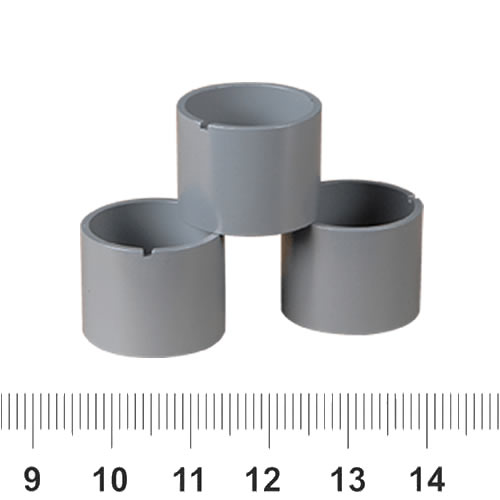
Multipolar Anisotropic NdFeB Ring Magnets, Plastic Compression Bonded Neodymium Magnets, Anisotropic Ring Pressed Bonded Magnets, NdFeB Plastic Bonded Magnets, anisotropic NdFeB radiation unipolar and multipolar ring magnets
Multipolar Anisotropic NdFeB Ring Magnets Item No. ABNM-07
Format: Any other dimensions can be supplied to order. The ring is gray epoxy coated.
Maximum working temperature: 80ºC
Observations: This manufacturing method allows for the creation of more complex geometric shapes. Pressed bonded magnets therefore have a variety of applications. Some examples are magnetic parts in motors, magnetic encoders for domestic white goods, washing machines, the automotive industry, etc.
Measurements: According to customer specifications.
Plastic bonded magnets can be pressed and injected. Pressed bonded magnets are the result of combining thermoplastic binders and powdered permanent magnets. They can be made in isotropic and anisotropic qualities. They show excellent mechanical properties allowing us to achieve tight tolerances, making balance and assembly easier and creating complex geometries. MPCO manufactures plastic bonded magnets for big companies in different sectors, such as electric motors and electrical appliance manufacturers and automotive companies. Maximum temperatures of between 100ºC and 120ºC are obtained.
Compression molding suitable anisotropic magnet powder had not been established facing the difficulty of contradiction of high density and magnet powder alignment. By applying both magnetic field and pressure at the moment when the resin is melted into liquid state by heating, both high density and a high degree of magnet powder alignment are attained. Furthermore, application of degassing and ultrasonic vibration were found to be effective. An anisotropic bonded magnet with the maximum energy of more than 20 MGOe, in other words, more than 80% of the theoretical value of maximum energy product, is obtained.
Bonded NdFeB magnets are strong magnets which are used for various applications. They are manufactured by binding rapid-quenching NdFeB powde mixed with resin to form a magnet by compression molding with epoxy or infection molding with nylon. The latter technique is particular effective in large volume production, though the magnetic value of products is lower than those made with compression molding because of their relatively lower density. Bonded NdFeB is easily machined. Coolants must be used while machining this material in order to avoid spontaneous combustion of powder. Machining this material removes a layer of protective coating, and re-coating for corrosion resistance may be necessary. Various shapes of high dimensional accuracy can be produced without further processing. Epoxy coating is mostly common used for bonded NdFeB magnets, nickel-plating is also used to prevent corrosion. anisotropic plastic bonded neodymium magnets
Related