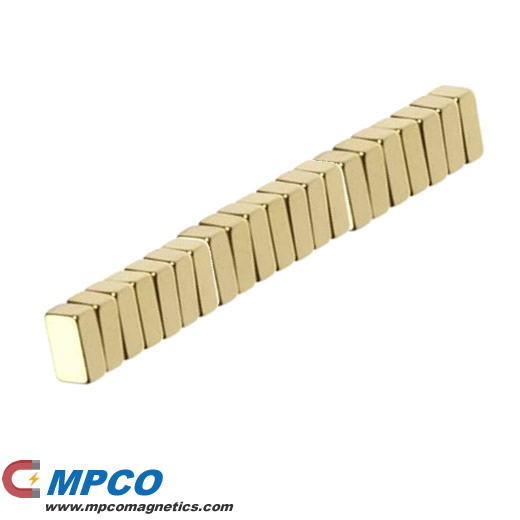
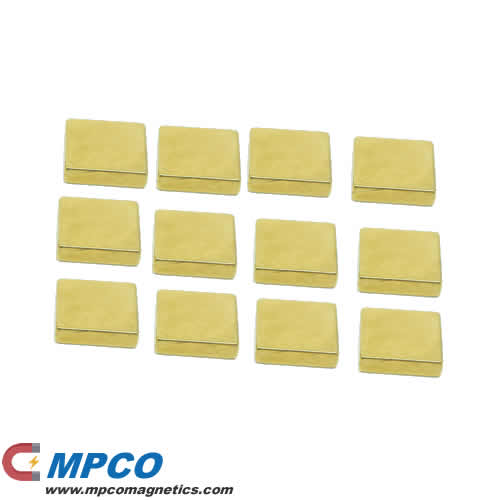
Small Sintered NdFeB Magnets with Titanium Nitride Coating, FDA Medical Used Titanium Nitride Plating NdFeB Blcok Magnets, physical vapor deposition (PVD) COATED Rare Earth Neodymium Rectangle Permanent Magnets, Titanium Nitride (TiN) Biocompatible Plating Strong Magnets China Manufacturer
Small Sintered NdFeB Magnets with Titanium Nitride Coating NdFeB Blcok N35 China Factory – Size: Length 6mm * 4mm * Thickness 2mm
Medical industry is a relatively high-end application to the permanent magnets, especially in-body use. The FDA requires medical magnets must have approved biocompatible coating, such as parylene-coated magnets and Titanium Nitride coated magnets.
Preparation methods of Titanium Nitride coating include chemical vapor deposition (CVD) technology and physical vapor deposition (PVD) technology, and MPCO team utilizes PVD technology to fabricate Titanium Nitride coated magnets.
Now MPCO Magnetics can supply TiN coated Neodymium magnet disks, bars and blocks.
Titanium nitride is an extremely hard ceramic material, often used as a coating on titanium alloys, steel, carbide, and aluminium components to improve the substrate’s surface properties. Applied as a thin coating, TiN is used to harden and protect cutting and sliding surfaces, for decorative purposes, and as a non-toxic exterior for medical implants. In most applications a coating of less than 5 micrometres is …
Sintered NdFeB magnets have poor corrosion resistance that renders them susceptible to corrosion in industrial and marine environments. This paper evaluates the properties of cathodic arc physical vapour deposited (CAPVD) titanium nitride coating for corrosion protection of sintered NdFeB permanent magnets. The performance of titanium nitride coating has been compared to the electrodeposited nickel–copper–nickel multilayer coating. The rates of coatings degradation in simulated marine environment were estimated with electrochemical impedance spectroscopy (EIS). Cyclic polarization was carried out to assess the pitting potential. The surface chemistry and coating morphologies were studied with scanning electron microscope (SEM). X‐ray diffraction (XRD) was used for qualitative phase analyses of coatings and the substrate. It was figured out that the charge transfer resistance of CAPVD titanium nitride coating increased with exposure time. The negative rate of Rp‐degradation for titanium nitride coating compared to the nickel–copper–nickel multilayer for equivalent exposure time is a unique and valuable result. Polarization results showed that ‘pits re‐passivation’ of titanium nitride coating could be responsible for the extended corrosion protection of the NdFeB substrate. The magnetic properties remained comparable for both types of coatings. FDA Medical Used Titanium Nitride Plating Magnets NdFeB Blcok
Nickel coated item
No additional coating except the base Ni-Cu-Ni coating. Looks good, although it happened to me once that a small chip of coating came off.
Black Nickel coated item
Is this post-treaded NiCuNi, or are there alternate ways? They do call it black nickel. From up close, the black plating looks uneven in some places; it is not really smooth. Also they give me black fingers when playing with them
Silver
Looks good, according to the manufacturer this is actually a NiCuNiAg plating. I’m aware that silver is a soft metal and is not very resistant to abrasion.
Gold
Also looks good. This is a NiCuNiAu plating (24 carat). Here goes the same as the silver item; gold is soft so it can fade and maybe even wear off over time.
Copper
NiCuNiCu… Quality is very poor. Color isn’t even copper-red, more pink-like. Doesn’t chip off, but surface looks cracked. Fairly easy to wipe off the color even with my fingers.
Zinc
NiCuNiZn… More durable than the copper one, but the surface also looks cracked. Color is quite bright blue. Not a nice metal finish.
Related