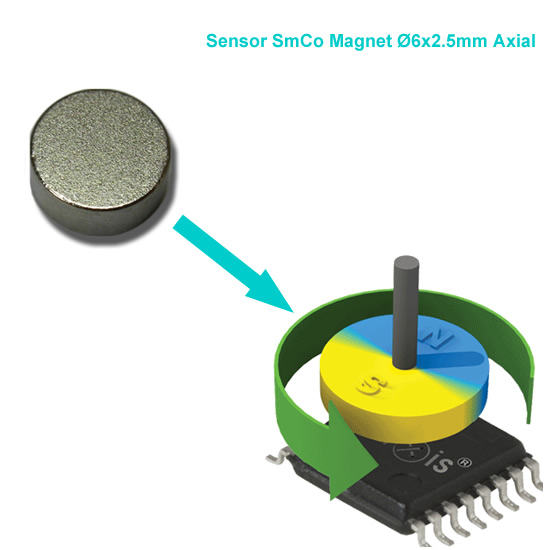
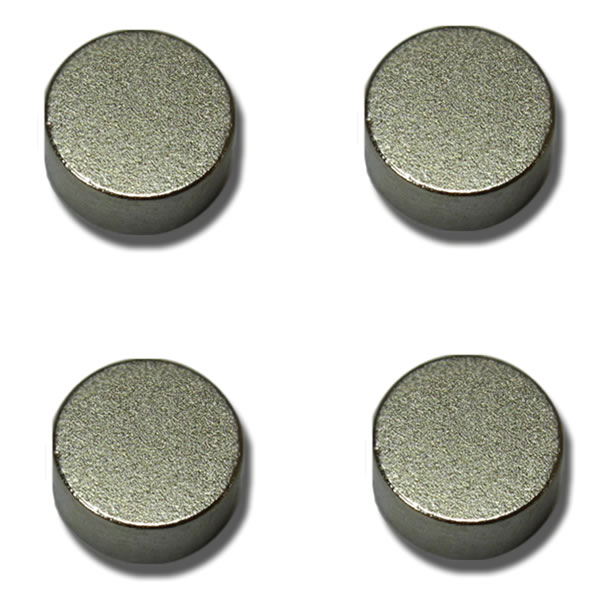
Disk SmCo Sensor Magnet Ø6×2.5mm Axial, Samarium-Cobalt Round Rare Earth SmCo permanent magnets for Melexis Triaxis 3D Linear & Rotary Position Sensor, Sintered SmCo Disc Magnets
Disk SmCo Sensor Magnet Ø6×2.5mm Axial Data Sheet:
Item No. Sm-SDM-6025A
Dimensions Discmagnet Ø6 x 2.5mm (±0.05mm)
Material SmCo, anisotrop sintered
Plating Nickle
Magnetization Axial
Magn. Asymmetrie max. ±3° (Sensor-Grade Magnet)
Magnetic properties:
BH(max) 212.5 KJ/m3 (typ.)
Br 1065 mT (typ.)
Hcj 1632 kA/m (typ.)
Hcb 776 kA/m (typ.)
Tc -0.032 %/°C (typ.)
Curie Temperatur 800°C (min.)
Working Temperatur 300°C (typ.)
Samarium cobalt magnets (SmCo) are composed of samarium, cobalt and iron. These rare earth magnets are extremely strong for their small size and are the second-strongest type of permanent magnet made. Their max energy product is at least three times that of alnico 8 and at least five times that of ferrite. SmCo has higher temperature ratings and higher coercivity than neodymium. They are also highly corrosion resistant and do not require a coating. disc sensor smco magnet
Attributes of Samarium-Cobalt Magnets
Often referred to in the industry as SmCo Magnets.
More expensive than other materials
High Hc and Hci
High Bhmax
Can withstand high operating temperatures, up to 350°C.
Powerful for size
Corrosion resistant and do not require a coating
Samarium-Cobalt magnets are brittle, and prone to cracking and chipping. Allowing magnets to snap together will cause the magnets to shatter.
Samarium-Cobalt Price Sensitivity
Due to the Cobalt content used to manufacture these magnets, Samarium-Cobalt Magnets fluctuate in price more than other materials.
Angle Position On-Axis
The magnetic rotary position sensor product family detects the absolute angular orientation of an on-axis two-pole magnet rotating over the center of the IC. The absolute angular position can be provided in various formats, including PWM, ABI and UVW, or directly read through the host interface. According to the application’s requirements, resolutions from 8-bit up to 14-bit are available. This technology can be employed in high-accuracy angle position detection, high-speed rotation systems and brushless DC motor control. Any rotary magnetic position sensor can replace either absolute or incremental optical sensors, other magnetic and inductive technologies, potentiometers or magnetic switches.
Related