

Complete Guide OF Injection Molded NdFeB Magnets
NdFeB magnets are widely used because of their excellent magnetic performance. Among various molding methods, injection molding is an important process for producing complex structures and precision magnetic components. It combines magnetic powder with thermoplastic resin and uses injection molding equipment to form the product. This process combines the functionality of magnetic materials with the processing advantages of plastics.
Key Takeaways
Injection molded NdFeB magnets combine NdFeB magnetic powder with thermoplastic resins such as PA6, PA12, PA66, and PPS.
They offer high dimensional accuracy, good consistency, flexible structures, and good toughness compared with traditional sintered magnets.
The manufacturing process covers material inspection, drying, injection molding, machining, magnetization, and final inspection.
Custom structures, multi-pole magnetization, and integrated molding make them suitable for motors, automotive components, sensors, appliances, and automation equipment.
Material, dimensions, magnetization, and packaging can be customized according to product requirements and application conditions.
What Are Injection Molded NdFeB Magnets?
Injection molded NdFeB magnets are a type of bonded NdFeB magnet. The basic principle is to mix NdFeB magnetic powder with a thermoplastic binder resin in a certain proportion. Common resins include PA6, PA12, PA66, and PPS. The mixture is then formed into magnetic components through the injection molding process.
Compared with sintered NdFeB magnets, injection molded NdFeB magnets generally have lower magnetic performance. However, they offer high dimensional accuracy, good batch-to-batch consistency, good toughness, and flexible structural design. Different magnetization methods can also be used to achieve the required magnetic field distribution based on the product structure and application requirements.
Typical Technical Parameters of Injection Molded NdFeB Magnets:
Parameter Value
Residual Induction Br 4500–6800 Gs
Coercivity Hcb 3100–6100 Oe
Intrinsic Coercivity Hcj 6700–6900 Oe
Maximum Energy Product BHmax 3.3–8 MGOe
Density 4.7–5.9 g/cm³
Tensile Strength 35–46 MPa
Shrinkage 0.4–0.5%
Tip: Different polymer materials can be selected according to customer requirements, such as PA6, PA12, and PPS. The corresponding reference temperatures are PA6: 120°C, PA12: 150°C, and PPS: 180°C.
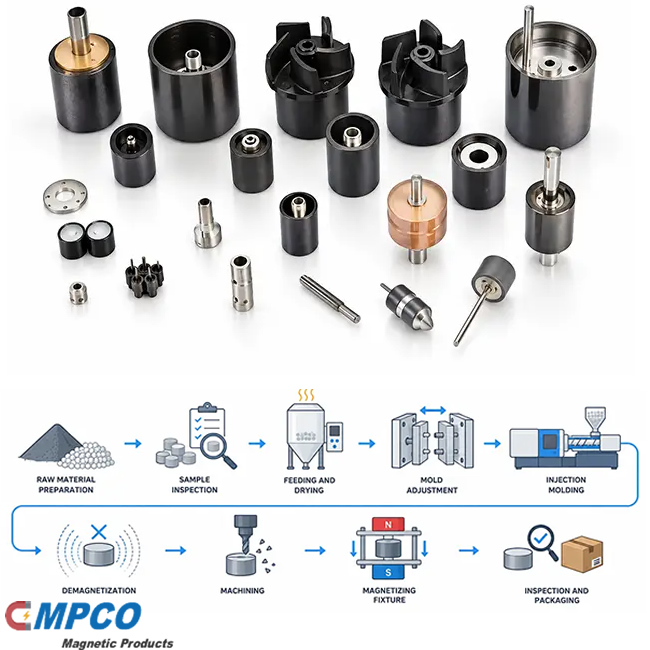
Complete Guide OF Injection Molded NdFeB Magnets
How Are Injection Molded NdFeB Magnets Manufactured?
Injection Molded NdFeB Magnets Manufactured process
The basic manufacturing process of injection molded NdFeB magnets can be summarized as:
NdFeB Raw Material → Sample Inspection → Feeding and Drying → Mold Adjustment → Injection Molding → Demagnetization → Machining → Magnetizing Fixture → Inspection and Packaging
1. Raw Material Preparation: According to product requirements, suitable NdFeB magnetic powder is selected and mixed with thermoplastic binders such as nylon or PPS in a specific proportion. The materials are then compounded and pelletized to form injection-grade composite pellets.
2. Sample Inspection: Each batch of raw material pellets is sampled and tested. The inspection includes magnetic properties, flowability, density, and other parameters. Production can begin after the materials meet the required production standards.
3. Feeding and Drying: The pellets have relatively high moisture absorption. Before injection molding, they must be thoroughly dried using drying equipment at a specified temperature. This removes moisture and helps prevent bubbles, sink marks, and other surface or internal defects during injection molding.
4. Mold Adjustment: According to the product drawing and mold structure, the temperature, pressure, injection speed, and clamping parameters of the injection molding machine are adjusted. This helps ensure stable molding.
5. Injection Molding: The dried pellets are heated and melted. The molten material is then injected into the mold cavity under high pressure. After cooling and solidification, the part is demolded to form the magnetic blank. If required, a directional magnetic field can be applied during molding to achieve anisotropic orientation.
6. Demagnetization: Before machining, the magnetic blank is demagnetized. This removes residual magnetism from the workpiece and magnetism generated during production. It helps prevent machining chips from being attracted to the workpiece and reduces potential effects on machining accuracy and equipment safety.
7. Machining: The molded part is processed to remove gates and flash. Critical dimensions can also be precision machined to ensure that the product meets the required dimensional tolerances.
8. Magnetizing Fixture: A customized magnetizing fixture is used to magnetize the magnet according to the product design requirements. The magnetizing waveform and number of poles can be customized according to customer requirements.
9. Inspection and Packaging: Finished products are inspected for magnetic properties, appearance, and dimensions. Qualified products are packaged according to customer requirements and shipped with an inspection report.
Advantages of Injection Molded NdFeB Magnets
Complex Structures and Integrated Molding
Injection molding can form specific magnetic components according to the mold structure. Insert molding can also be used to combine the magnetic material with metal shafts, housings, rotor cores, and other components. This enables the integration of magnetic components and structural parts.
This method can reduce some separate components and subsequent assembly processes. It is suitable for motors, rotors, and magnetic assemblies that require a high level of structural integration.
High Dimensional Accuracy and Consistency
Injection molding provides high dimensional accuracy and good batch-to-batch consistency. Some products can meet assembly requirements directly after molding. Critical dimensions can also be precision machined according to the product design. This helps reduce some machining and assembly processes.
Flexible Structural Design
We have a plastic magnet mold manufacturing workshop. We can develop injection molds according to customer drawings. Our equipment includes CNC lathes, precision engraving machines, middle wire EDM, and slow wire EDM. These capabilities support highly customized product structures.
For magnetization, axial single-pole, radial multi-pole, and axial-radial combined magnetization can be provided. Magnetizing waveforms and the number of poles can also be customized according to requirements.
Low Density and Impact Resistance
Plastic magnets have low density and high impact strength. They can be processed by cutting, drilling, and grinding without being easily broken. Compared with relatively brittle sintered magnets, they are more suitable for applications involving vibration or impact.
Stable Magnetic Performance
Although injection molded NdFeB magnets have lower magnetic performance than sintered magnets, their performance is stable and consistent within their respective grades. They can meet applications such as precision motors and sensors that require stable magnetic performance.
Applications of Injection Molded NdFeB Magnets
Injection molded NdFeB magnets are mainly used for magnetic components that require precision structures, dimensional consistency, and specific magnetization methods.
Motor and Micro Motor Applications: Widely used in stepper motors, DC motors, servo motors, brushless motor rotors, and various micro motor applications.
Automotive Industry: Used in automotive actuators, fuel system stepper motors, ABS magnetic sensor components, automotive motor rotors, and automotive sensor rings.
Household Appliances: Used in fan motors, air-conditioning actuators, washing machine drain valve motors, vacuum cleaners, refrigerators, and other household appliance components.
Electronics and Office Equipment: Used in speaker and earphone magnets, small drive motors, cooling fans, magnetic rollers, sensor components, and magnetic components in office equipment.
Industrial Equipment and Automation: Used in industrial robot magnetic sensors, magnetic switches, workpiece holding magnets, precision actuators, and magnetic components for automation equipment.
Other Magnetic Components: Depending on the specific design, injection molded NdFeB magnets can also be used in instruments, consumer electronics, and other products that require precision molded magnets.
Inductor Magnet Ferrite Bonded Injection Molding for Agricultural Tools
Electro Permanent Magnets for Injection Moulding Machines
Alignment Technique for Anisotropic Injection Magnets
Injection Ferrite Ring Pneumatic Cylinder Positioning Magnet
Standard Air Cylinder Magnet Injection Mould Ferrite Ring
Pneumatic Cylinder Sensor Magnet Injection Plastic Ferrite Material
Injection Ferrite Pneumatic Cylinder Magnet Ring
Inductor Injection Molding Nd Magnet for Embedded Permanent Magnet Synchronous
