magnetic properties

/Tag:magnetic properties
  • How Continuous Drawer Magnets Work

How Continuous Drawer Magnets Work

How Continuous Drawer Magnets Work Continuous drawer magnets are specialized magnetic separation devices designed to remove ferrous contaminants from bulk materials during processing. These magnets are particularly effective in industries where product purity is critical, such as food processing, plastics manufacturing, and recycling. By integrating these magnets into production lines, companies can enhance the quality [...]

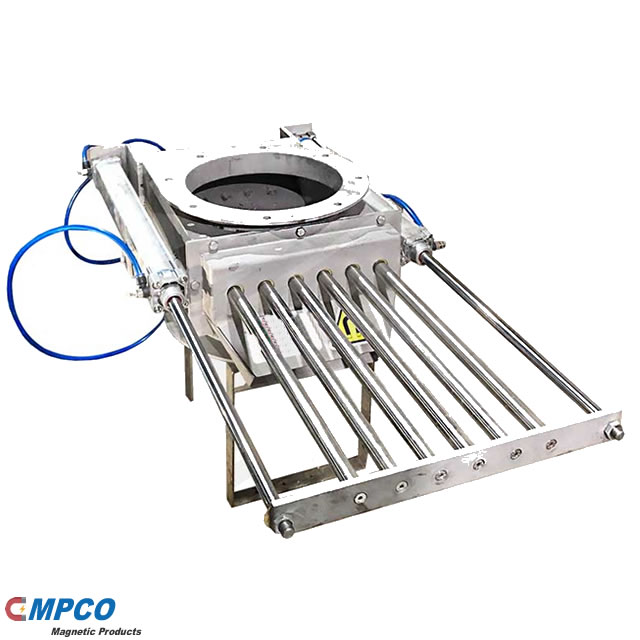
  • Continuous Flow Drawer Magnets

Continuous Flow Drawer Magnets

Magnetic Continuous Flow Drawer Magnets are innovative devices designed to efficiently remove ferrous contaminants from dry bulk materials in various industrial processes. Our powerful magnets are typically installed in the chute or pipeline systems, allowing the continuous flow of materials while capturing and retaining unwanted metal particles. The high-strength magnetic field ensures effective separation of [...]

  • Self Cleaning Drawer Magnets

Self Cleaning Drawer Magnets

Self clean drawer magnets are innovative magnetic separation solutions commonly used in industrial and manufacturing settings. Our specialized drawers are designed to efficiently remove ferrous contaminants from dry, free-flowing materials such as grains, powders, and granules. What sets them apart is their unique self-cleaning mechanism, which ensures continuous and uninterrupted operation. As the material flows [...]

  • Quick Clean Drawer Magnets

Quick Clean Drawer Magnets

Quick Clean Drawer Magnets are innovative magnetic separation solutions designed to efficiently and effectively remove ferrous contaminants from dry, free-flowing materials in industrial processes. Our magnets feature a user-friendly design that simplifies maintenance and cleaning procedures, reducing downtime and ensuring uninterrupted production. With their robust construction and powerful magnetic force, Quick Clean Drawer Magnets offer [...]

Nomenclature of NdFeB Grades

Nomenclature of NdFeB Grades Chinese Standard - commonly used globally, especially in EU Minimum Values Material Br Hcb (Hc) Hcj (Hci) (BH)max mT G kA/m Oe kA/m mT G kA/m N27   1,030 10,300 796 10,000 955 12,000 119 25 N30   1,080 10,800 796 10,000 955 12,000 223 28 N33   1,130 11,300 836 [...]

By |June 7th, 2024|Magnet News, Magnetic Knowledge, Magnetic Materials, NdFeB, Neodymium Magnets, Sintered NdFeB|Comments Off on Nomenclature of NdFeB Grades
  • Neodymium Motor Magnet

Neodymium Motor Magnet

Neodymium Motor Magnet is available, it is mainly used in automatic control system and long range linear motion device, we are offering the length 100 - 700mm. Neodymium magnet is widely used in magnetic motor and vehicle magnet applications, it is typically two to three times stronger than ferrite magnet, which results in greater performance [...]

By |March 5th, 2024|Ferrite Magnet, Magnet Applications, Magnetic Industry, Magnetic Materials, Motor Magnet, NdFeB, Neodymium Magnets, Sintered NdFeB|Comments Off on Neodymium Motor Magnet
  • Loss of Permanent Magnet Magnetization Due to Cold Temperatures Exposure

Loss of Permanent Magnet Magnetization Due to Cold Temperatures Exposure

Loss of Permanent Magnet Magnetization Due to Cold Temperatures Exposure Loss of magnetization due to cold temperatures exposure is a phenomenon that occurs in various types of materials, particularly in magnetic materials. This phenomenon is commonly known as the “superparamagnetic effect” or “temperature-dependent magnetization.” It results from the thermal agitation of the atomic spins in [...]

  • Loss of Permanent Magnet Magnetization Caused by Heat Exposure

Loss of Permanent Magnet Magnetization Caused by Heat Exposure

Loss of Permanent Magnet Magnetization Caused by Heat Exposure Loss of Magnetization Caused by Heat Exposure - Exposing a magnet to high temperatures can decrease its strength or permanently damage its structure. Usually this happens at very high temperatures, but for certain neodymium magnets this can happen as low as 60°C. Magnets are characterized by [...]

  • Customised Magnets for The Automotive Industry

Customised Magnets for The Automotive Industry

Customised Magnets for The Automotive Industry Automotive challenges The automotive industry operates according to the Just-In-Time (JIT) principle. One of the prerequisites for successful JIT production is a reliable supply chain of suppliers that meet the defined quality requirements. It is important that they can respond to changes in prices, specifications and forecasts. This keeps [...]

  • How are Magnets Used in the Automotive Industry

How are Magnets Used in the Automotive Industry?

How are Magnets Used in the Automotive Industry? Vehicles need to be safer and more efficient than ever. Magnets are used in the automotive industry to achieve these goals and ensure a smoother car experience for us all. Find out more about how exactly they’re used and why they’re important not only for vehicle safety [...]

  • Where are Samarium Cobalt Magnets Useful

Where are Samarium Cobalt Magnets Useful?

Where are Samarium Cobalt Magnets Useful? All the information you need to be an informed buyer of Samarium Cobalt Magnets right here, for free! Samarium Cobalt Magnets are among the second most common rare earth magnets. They can be used in temperatures on both the hottest and coldest end of the spectrum (although some swings [...]

  • The Complete Guide of Neodymium Magnets

The Complete Guide of Neodymium Magnets

The Complete Guide of Neodymium Magnets NEODYMIUM MAGNETS: THE STRONGEST COMMERCIALLY AVAILABLE MAGNETS Neodymium Magnets are really Strong Magnets made by an alloy of neodymium, iron and boron (NdFeB). Neodymium is a rare-earth element (REE), also called rare-earth metal or (in context) rare-earth oxide. Even at their smallest size Neodymium Magnets have a Really High [...]

error: Content is protected !!