Sintered Ferrite magnets

/Tag:Sintered Ferrite magnets
  • Complete Guide OF Injection Molded NdFeB Magnets

Complete Guide OF Injection Molded NdFeB Magnets

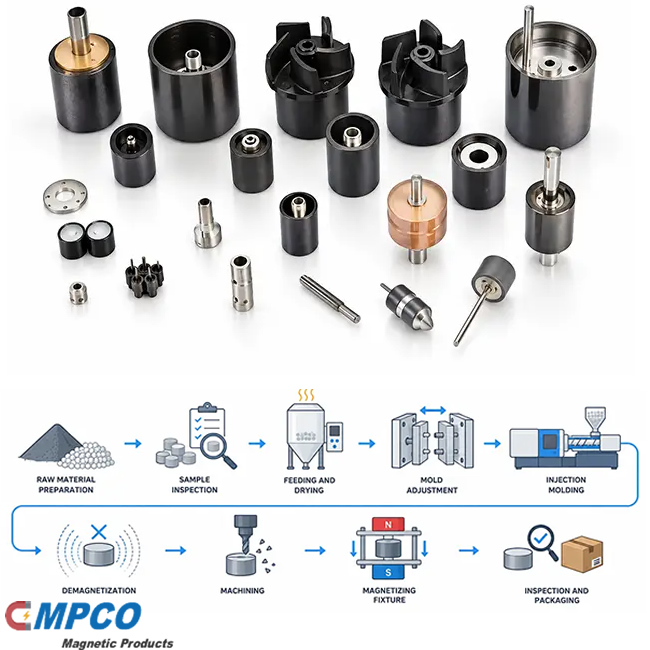
Complete Guide OF Injection Molded NdFeB Magnets NdFeB magnets are widely used because of their excellent magnetic performance. Among various molding methods, injection molding is an important process for producing complex structures and precision magnetic components. It combines magnetic powder with thermoplastic resin and uses injection molding equipment to form the product. This process combines [...]
  • Injection Molded vs. Sintered Ferrite Ring Magnets

Injection Molded vs. Sintered Ferrite Ring Magnets

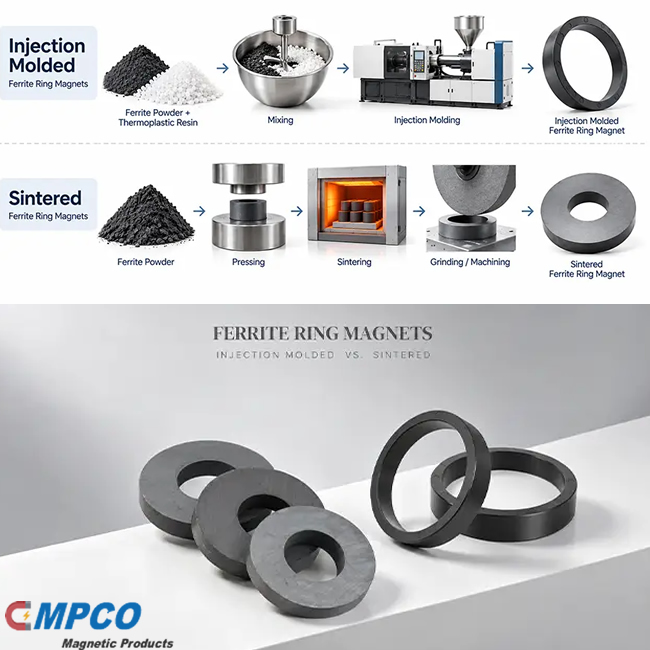
Injection Molded vs. Sintered Ferrite Ring Magnets Injection molded ferrite ring magnets and sintered ferrite ring magnets are both commonly used permanent magnet components in motors. However, they have clear differences due to their different manufacturing processes and material structures. In comparison, injection molded ferrite ring magnets focus more on design flexibility and production efficiency, [...]

By |October 18th, 2026|Ferrite Magnet, Home, Magnet Applications, Magnetic Industry, Magnetic Knowledge, Magnetic Materials, Magnetic Products, Magnetic Science, Motors, Separation Magnets, Sintered Ferrite Magnet|Comments Off on Injection Molded vs. Sintered Ferrite Ring Magnets
  • Injection Molded Ferrite Ring Magnets for Fan Motors

Injection Molded Ferrite Ring Magnets for Fan Motors

Injection Molded Ferrite Ring Magnets for Fan Motors Injection molded ferrite ring magntes are commonly used as permanent magnetic components in fan motor rotors. They are widely used in table fans, pedestal fans, wall fans, ceiling fans, and other fan motor products. Compared with other magnetic material solutions, injection molded ferrite rings offer advantages in [...]

By |October 16th, 2026|Ferrite Magnet, Home, Magnet Applications, Magnetic Industry, Magnetic Knowledge, Magnetic Materials, Magnetic Products, Magnetic Science, Motors, Separation Magnets, Sintered Ferrite Magnet|Comments Off on Injection Molded Ferrite Ring Magnets for Fan Motors
  • Wet Press vs Dry Press Ferrite Magnets

Wet Press vs Dry Press Ferrite Magnets

Wet Press vs Dry Press Ferrite Magnets Permanent ferrite magnets can be divided into two manufacturing processes based on their forming methods: wet pressing and dry pressing.The forming process not only affects the internal grain orientation and magnetic performance of ferrite magnets, but also influences production efficiency, dimensional control, and final application performance.Understanding the differences [...]

  • How to Identify the North and South Poles of Arc Magnets

How to Identify the North and South Poles of Arc Magnets?

How to Identify the North and South Poles of Arc Magnets? Arc magnets, also known as curved magnets or tile magnets, are one of the most widely used magnet types in motors. Their unique curved design allows them to fit the rotor or stator more effectively, making them an essential component in various motor applications. [...]

  • Magnet Temperature Limits Maximum Operating Temperature vs Curie Temperature

Magnet Temperature Limits: Maximum Operating Temperature vs Curie Temperature

Magnet Temperature Limits: Maximum Operating Temperature vs Curie Temperature Temperature is one of the key factors affecting the performance and reliability of permanent magnets. Beyond a certain temperature threshold, magnets may even undergo irreversible demagnetization. Therefore, understanding the temperature limitations of magnets is crucial when selecting suitable magnet materials for specific applications. When evaluating the [...]

  • Comparing N50 vs. N52 Magnets

Comparing N50 vs. N52 Magnets

Comparing N50 vs. N52 Magnets Many customers are confused and don’t know what to choose between N50 and N52. They know these are both strong magnets, but they don’t know what the difference is, and they don’t know which one they should use. N52 magnets are generally stronger than N50 magnets, making them the preferred [...]

  • N56 Neodymium Magnets

N56 Neodymium Magnets

N56 neodymium magnets - MPCO provide reliable magnetic support for various high-end and precision devices due to their excellent maximum energy product, remanence, and coercivity metrics. Meaning of the N56 Neodymium Magnet Grade Taking the N56H grade as an example: The letter N stands for neodymium (Nd) in English. The number 56 indicates the maximum [...]

  • Flat Magnet

Flat Magnet

Understanding Flat Magnet Flat magnets, also known as thin magnets, are a specific type of magnet characterized by their small thickness, typically ranging from 0.4 mm to 2 mm. They are made from various magnetic materials and come in different shapes and sizes, making them versatile for numerous applications. Composition of Flat Magnet Flat magnets [...]

  • What is Flat Magnets

What is Flat Magnets?

What is Flat Magnets? Flat magnet as one of our advantage products, it is necessary to introduce what is flat magnets, flat magnet are what material made? And shape types of flat magnets. What is a flat magnets? Flat magnets, also known as thin magnets, are generally small in thickness, ranging from 0.1mm to 2mm. [...]

  • Temperature Performance of Neodymium Magnets

Temperature Performance of Neodymium Magnets

Temperature Performance of Neodymium Magnets Neodymium magnets are a very widely used type of rare-earth permanent magnets. Due to their extremely high magnetic properties, neodymium magnets have a wide range of applications in industry and daily life. However, the magnetic properties of neodymium magnets are sensitive to temperature, so understanding their temperature limitations is essential [...]

  • Loss of Permanent Magnet Magnetization Due to Cold Temperatures Exposure

Loss of Permanent Magnet Magnetization Due to Cold Temperatures Exposure

Loss of Permanent Magnet Magnetization Due to Cold Temperatures Exposure Loss of magnetization due to cold temperatures exposure is a phenomenon that occurs in various types of materials, particularly in magnetic materials. This phenomenon is commonly known as the “superparamagnetic effect” or “temperature-dependent magnetization.” It results from the thermal agitation of the atomic spins in [...]

error: Content is protected !!