

Magnetic Drums, Pulleys, and Rolls
Magnetic drums, pulleys, and rolls are essential components used in various industrial applications, particularly in the field of material handling and separation processes. These devices leverage the power of magnetism to efficiently sort, transport, or extract ferrous materials from a mixture of substances. Magnetic drums, often rotating cylindrical units, are employed in conveyor systems to attract and collect magnetic particles, ensuring the purity of the conveyed materials. Magnetic pulleys, on the other hand, are mounted at the ends of conveyor belts to facilitate automatic separation of magnetic materials from non-magnetic ones. Magnetic rolls are typically utilized in mineral processing and recycling industries, employing a combination of magnetic force and gravity to separate materials of different magnetic properties. These magnetic components play a crucial role in streamlining industrial processes, enhancing product quality, and reducing waste
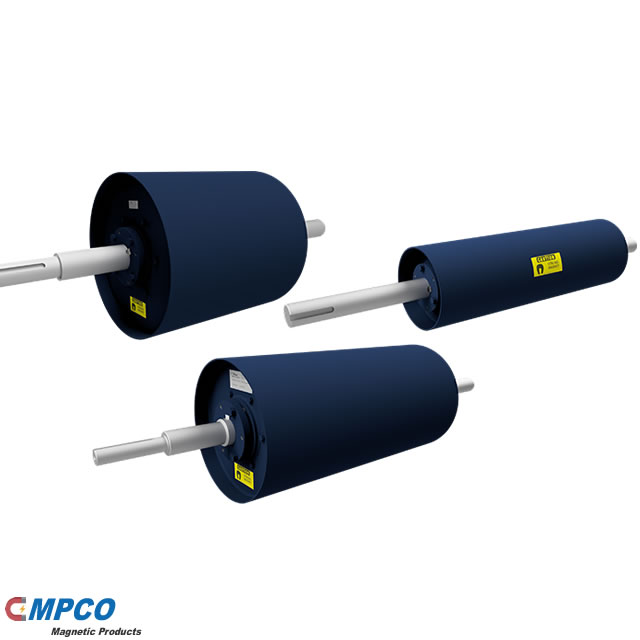
1. Magnetic Drums
Magnetic drums are rotating cylindrical units that play a crucial role in conveyor systems. They are designed to attract and collect magnetic particles from non-magnetic materials as they pass over the drum. This process ensures the purity of the conveyed materials by removing unwanted ferrous contaminants.
Types of Magnetic Drums:
Magnetic Barrel: This type features a magnetic sector with an angle of 180 degrees that rotates around a stainless steel drum. It is commonly used for conveyor belts.
Drum Magnets with Covers: These are drum magnets enclosed within a protective casing that facilitates the separation of raw materials and ferromagnetic impurities.
Magnetic Drive Rolls: These consist of a solid magnetic sector with a full 360-degree angle and are typically used instead of reversing drum conveyor belts.
2. Magnetic Pulleys
Magnetic pulleys serve as effective tools for automatic separation at the ends of conveyor belts. They are mounted in such a way that they can continuously remove tramp iron contamination from both large and fine metal particles during material processing.
Features:
Available in various sizes (4”, 6”, 8”, 12”, 15”, 16”, and 18”).
Constructed with durable stainless steel shells.
Designed for high-performance applications across multiple industries including recycling, food processing, and mining.
3. Magnetic Rolls
Magnetic rolls are primarily utilized in mineral processing and recycling industries. They employ both magnetic force and gravity to separate materials based on their differing magnetic properties.
Operational Principle:
The operation involves passing mixed materials over the roll where magnetic forces attract ferrous materials while allowing non-magnetic substances to fall away due to gravity. This method enhances efficiency in sorting operations.
Applications Across Industries
These magnetic components find extensive use across various sectors:
Recycling Industry: For separating metals from non-metals (e.g., aluminum cans).
Mining Industry: To remove impurities from mined materials.
Food Processing: Ensuring product purity by eliminating metal contaminants.
Wood Processing: In recycling wood products to recover valuable metals.
Advantages of Using Magnetic Drums, Pulleys, and Rolls
Efficiency: They provide continuous operation without requiring manual intervention.
Quality Control: Enhance product quality by ensuring that contaminants are removed before further processing.
Cost-effective: Reduce waste by improving recovery rates of valuable materials.
In summary, magnetic drums, pulleys, and rolls are essential tools in modern industrial processes aimed at enhancing efficiency, ensuring product quality, and minimizing waste through effective separation techniques.
