

Processing-Driven Microstructure Control in Additively Manufactured Alnico Permanent Magnets
This work investigates the process–structure–property relationships in cobalt-free Alnico-3 permanent magnets fabricated using directed energy deposition (DED), a laser-based additive manufacturing technique. Systematic variation of laser power, scan speed, and powder mass flow rate is considered through the framework of global energy deposition (GED), a derived parameter that consolidates energy input across operating conditions. Microstructural characterization reveals that as-deposited samples develop columnar grains whose size increases with GED, while heat treatment drives spinodal decomposition into the functional two-phase microstructure comprising ferromagnetic Fe-rich α1 rods embedded in a Ni–Al-rich α2 matrix. Magnetic measurements show high saturation magnetization (~ 120 emu/g) in all states, with measurable coercivity in the as-processed condition that increases with GED. However, maximum coercivity and remanence are achieved only after post-deposition aging, particularly under lower GED, where refined α1/α2 features enhance domain wall pinning. Transmission electron microscopy and Lorentz imaging confirm α1/α2 interfaces as active pinning sites, directly linking nanoscale phase morphology to magnetic response. Collectively, these results demonstrate the pivotal role of thermal history in tailoring phase separation and establish DED, guided by GED-based process optimization, as a promising pathway for manufacturing high-performance, sustainable, rare-earth, and cobalt-free permanent magnets.
Processing-Driven Microstructure Control in Additively Manufactured Alnico Permanent Magnets
Alnico magnets—comprising aluminum (Al), nickel (Ni), cobalt (Co), and iron (Fe), with minor additions of copper (Cu) and titanium (Ti)—were first developed in the 1930 s and represent one of the earliest classes of high-energy permanent magnets.1 Their magnetic performance is derived from a finely tuned, spinodally decomposed two-phase microstructure, in which Fe–Co-rich magnetic rods are embedded within a non-magnetic Al–Ni-rich matrix.1 This phase-separated microstructural heterogeneity imparts high remanence (Br ~ 1.2–1.3 T) and exceptional thermal stability, with Curie temperatures exceeding 800 °C and reliable performance up to 500–550 °C, well beyond the thermal limits of rare-earth-based magnets.2,3 Although their intrinsic coercivity (250–750 Oe, depending on the specific grade and processing conditions) and subsequent magnetic energy product (BHmax ≈ 1–10 MGOe) are modest relative to rare-earth supermagnets such as Nd2Fe14B (BHmax > 50 MGOe) and SmCo5 (BHmax ~ 20–30 MGOe),4 Alnico’s combination of performance, sustainability, and thermal resilience has led to renewed interest in its development for next-generation applications.
Conventional processing routes such as casting and powder metallurgy have long been employed to achieve the spinodally decomposed microstructure in Alnico alloys. Directional casting can produce aligned columnar grains that enhance remanence, but this method is constrained by slow cooling rates, high energy demands, and limited geometric flexibility.5 Powder metallurgy approaches, including sintering and hot pressing, provide improved compositional control and grain refinement; however, they often suffer from porosity, restricted part size, and difficulty in developing crystallographic texture.6 Both routes also rely heavily on post-processing heat treatments to promote spinodal decomposition and optimize magnetic performance, yet they provide limited ability to influence microstructure during solidification.
In recent year, additive manufacturing (AM) is rapidly emerging as a powerful platform for fabricating functional magnetic materials, offering new opportunities for controlling composition, geometry, and thermal history.7 Under appropriate processing conditions, AM can influence solidification rates and thermal gradients in ways that may promote tailored microstructural features, such as grain morphology, crystallographic texture, and phase separation, that critically influence magnetic performance.8,9,10,11,12,13 In particular, laser-based methods such as directed energy deposition (DED) and powder bed fusion (PBF) are especially promising due to their ability to provide localized thermal control and achieve rapid cooling rates in the range of 104–106 K .14,15,16,17 These conditions enable access to non-equilibrium phase transformation pathways, similar to those achieved via melt-spinning, a rapid solidification technique historically used to refine magnetic microstructures, allowing laser-based AM to promote the formation of metastable or finely tuned phase morphologies critical to enhanced magnetic performance.3,18,19 Compared to casting and powder metallurgy, DED further allows for layer-by-layer fabrication and greater geometric flexibility, potentially reducing reliance on extensive post-processing and enabling scalable, near-net-shape parts with tailored microstructural features. Importantly, Alnico alloys, with their high thermal conductivity (~ 30 W/m K) and moderate melting range (~ 1450–1550 °C),20 are particularly amenable to laser-based AM, as their thermal properties help mitigate residual stress, hot cracking, and distortion during deposition.
Despite the thermal and processing advantages offered by laser-based AM, the magnetic performance of as-built Alnico remains significantly constrained, largely due to the absence of crystallographic texture and incomplete phase separation, both essential for coercivity and anisotropy.21 In particular, developing a well-oriented spinodally decomposed microstructure comprising ferromagnetic Fe–Co-rich (α1) rods embedded within a non-magnetic Ni–Al-rich (α2) matrix is essential for optimal magnet functionality.21 Realizing such a microstructure requires precise thermal management during both deposition and post-processing stages to refine the α1/α2 morphology, relieve residual stresses, and align domains under an applied magnetic field.22
To address these challenges, this study investigates the fundamental relationships between DED process parameters, laser power, scan speed, and powder mass flow rate, and the resulting microstructural and magnetic behavior of Alnico alloys. Alnico-3 is selected as a model system due to its simplified composition, low cobalt content, and pronounced sensitivity to thermal history.23 which makes it a good candidate for probing phase evolution mechanisms under rapid solidification conditions. By examining how variations in energy of deposition during DED processing influence grain morphology, early-stage spinodal decomposition, and magnetic properties, this study seeks to elucidate the underlying process–structure–property relationships that govern magnetic response in non-equilibrium solidification environments. These results not only provide critical insights into phase transformation pathways in additively manufactured magnetic materials but also establish a framework for tailoring rare-earth-free magnets through process-optimized additive manufacturing.
Experimental Methods
Pre-alloyed AlNiCo 3 powders (Al–12 wt%, Ni–25 wt%, Cu–3 wt%, Fe–60 wt%) were obtained from American Elements. Following Ref.24, particle size distribution of the precursor powders was determined following ASTM B21416. Flowability was evaluated using a Hall flowmeter (Qualtech) per ASTM B213-11 by measuring the time for 50 g of powder to pass through a standard funnel, and by calculating the angle of repose was determined by analyzing the conical pile formed by powder flow using image analysis software, reported to the nearest 0.01°.25 Tap density was determined following ASTM B527-06 by applying controlled vibration to a graduated powder-filled cylinder. Apparent density was calculated from the untapped volume and sample mass, and the Hausner ratio was computed as the tap-to-apparent density ratio.25
After confirming the powders’ suitability for AM processing, cuboidal specimens (3 mm × 5 mm × 10 mm) were printed on 316L stainless-steel substrates using a powder-fed laser DED system at the Commonwealth Center for Advanced Manufacturing. The intelligent DED cell was equipped with a Precitec YC50 laser-blown powder head powered by a fiber-coupled diode laser source (Laserline LDF300-3000) capable of delivering up to 3 kW of continuous-wave output in the near-infrared (900–1030 nm) spectral range. The system was integrated with a Siemens Sinumerik 840D control unit, a 6-axis Comau RJ 40 robot platform, and a 2-axis trunnion table, enabling precise toolpath execution and build flexibility. Printing was performed with unidirectional scan strategies, using argon gas for powder transport and atmospheric shielding to minimize oxidation. The laser spot size was kept constant at 1.4 mm. Samples were spaced 2 cm apart, with a minimum 15-s dwell between builds to reduce thermal overlap
The experiment was conducted in two stages (see Table S1 in the supplement for the Design of the Experiment). In the first stage, key deposition parameters—laser power (P), scan speed (υ), laser spot diameter (d), and powder mass flow rate
—were systematically varied one at a time while holding the others constant to isolate the effect of each parameter on the properties of the 3D-printed specimens. In the second stage, process selection was guided by global energy deposition (GED), a derived parameter that captures the effective thermal energy input per unit volume of material by explicitly incorporating P, υ, d, and
, thus providing a robust, scalable framework for comparing and optimizing DED processes across different operating conditions. Following Webster et al.,26 it is defined as:
, with units J/(kg/s mm3).
Subsequently, specimens were transversely sectioned, and central regions extracted to minimize edge effects. Select samples were heat-treated under inert atmosphere, with homogenization at ~ 850 °C for 10 min, followed by controlled cooling to 550–800 °C over 4 h, based on phase diagram guidelines.27,28
Microstructure and magnetic properties were characterized using a suite of structural and magnetic probes. Phase analysis was performed using optical microscopy (Nikon Eclipse LV100D) and X-ray diffraction (Rigaku Ultima III; Cu-Kα, λ = 0.154 nm). Microstructural features and composition of the precursor powder was characterized using SEM (Hitachi SU-70) with integrated energy dispersive spectroscopy (EDS). A dual-beam 30-kV Ga+ focused ion beam instrument (FIB/SEM; Thermofisher Scios 2) equipped with electron backscatter diffraction (EBSD) orientation imaging was used to observe microstructural features such as grain size, aspect ratio, and crystallographic texture. Additionally, the EBSD orientation maps were used to select grains suitably oriented for subsequent transmission electron microscopy (TEM) characterization. Grains oriented with < 001 > family directions aligned to the TEM imaging direction were selected, as this imaging direction provides good contrast between the α1 and α2 phases created during spinodal decomposition.17 Using a standard FIB lift-out approach, material from the grain of interest was removed, placed on a TEM half grid, thinned to electron transparency, and polished with a 5-kV Ga+ beam to minimize surface damage. TEM characterization was carried out in a JEOL F200 TEM at 200 kV using a double-tilt beryllium holder. Conventional imaging was used to align the sample to the [001] zone axis and acquire diffraction patterns. High angle annular dark field (HAADF) imaging collected between 8.3 and 30.4 mrad was used to provide compositional contrast between the α1 and α2 phases, and EDS mapping was used to verify the phase separation. Differential phase contrast-based Lorentz imaging was carried out using software developed in-house (© 2023 Virginia Commonwealth University, Lorentz STEM imaging, All rights reserved). This software takes multiple brightfield images with the detector slightly off-center to quantify the beam deflection as it passes through a magnetic sample (a similar approach as taken in Lopatin et al.29). The objective lens current was varied to apply magnetic fields to the sample during TEM observation. Finally, bulk magnetic measurements were performed at room temperature using a vibrating sample magnetometer (Quantum Design VersaLab) under applied fields up to μ0H = 2 T.
The statistical significance of process parameter effects on macrostructural properties (track height and width), microstructural features, and magnetic responses was evaluated using analysis of variance (ANOVA), with F tests applied to determine factor significance and multivariate calculations used to assess parameter interactions, performed in both Origin Pro and JMP.
Results and Discussion
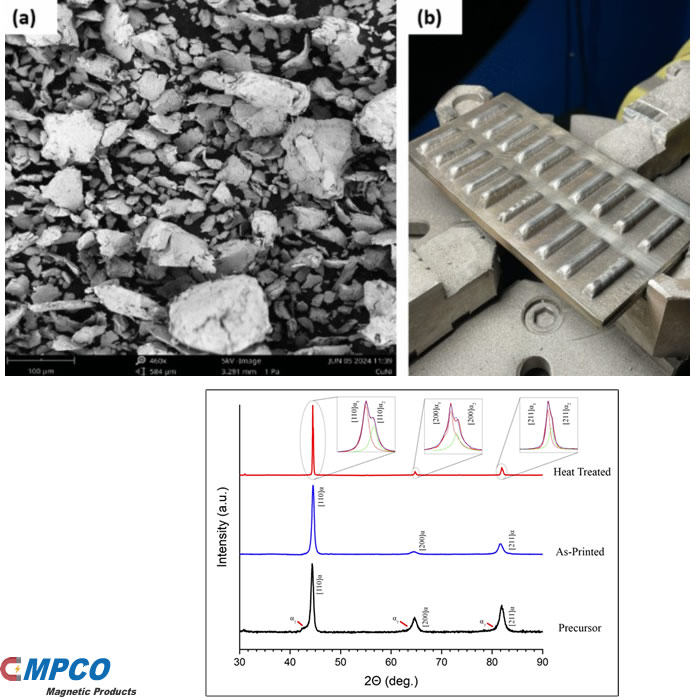
The SEM image of the pre-alloyed Alnico-3 powder, shown in Fig 1a, shows angular, faceted particles, characteristic of mechanical milling. Particle size distribution of the precursor powders determined via sieve analysis, following ASTM B214-16, yielded effective particle sizes of D10 ~ 35.7 µm, D50 ~ 89.5 µm, and D90 ~ 106.0 µm, which fall within the optimal range for DED powders (45–150 µm). While spherical powders are preferred for AM, DED can accommodate irregular shapes if the feed rate remains stable.30 Bulk and tap densities were measured as 2.99 g/cm3 and 3.71 g/cm3, respectively, with a Hausner ratio of 1.24, indicating fair flowability. Hall flow rate (1.61 g/s) and angle of repose (34°), per ASTM B213, fall within acceptable AM ranges.
These observations are consistent with the ANOVA results reported in the supplement and summarized in Table I. Overall, it was found that scan speed was the most significant factor affecting build height (p < 0.0001), followed by powder flow (p = 0.0059) and laser power (p = 0.0160). For track width, laser power dominated (p < 0.0001), followed by scan speed (p = 0.0005), while powder flow had no significant effect (p = 0.30). When the data were re-examined in terms of GED, no clear correlation with build height or width was observed (Fig. 2(d, e)). ANOVA likewise showed no significant effect of GED on build height (p = 0.4252) and only a weak influence on track width (p = 0.0298), far less than the direct effects of laser power (p < 0.0001) and scan speed (p = 0.0005). These results indicate that GED is not a robust predictor of track geometry. Nevertheless, qualitative trends in surface quality were evident. In particular, low GED produced rough, under-fused surfaces, high GED led to surface waviness due to overmelting, and moderate GED yielded smoother, more uniform tracks, delineating a practical processing window.
Table I Analysis of variance (ANOVA) results showing the relative influence of laser power, robot scan speed, powder mass flow rate, and global energy density on build height and track width of DED-processed Alnico samples
Full size table
Microstructural analysis reveals that the as-processed 3D-printed specimens exhibit a predominantly columnar grain structure oriented along the build direction (Fig. 3). This morphology is characteristic of DED processes, where columnar grains originate from epitaxial growth at the substrate–deposit interface and extend through successive layers, reflecting the cumulative thermal history and influence of overlapping melt pools.31 The absence of significant equiaxed grain formation suggests limited undercooling and nucleation events, consistent with the high energy density and directional cooling rates typical of laser-based DED. Grain size increases with GED, a trend attributed to forming larger, more thermally stable melt pools at higher GED values, which extend solidification time and reduce cooling rates (Fig. 3a–c). These conditions suppress nucleation, allowing existing grains to grow more extensively, resulting in a coarser columnar microstructure. Approximate grain widths increase from ~ 40–50 μm in low-GED conditions (Fig. 3a) to ~ 100–110 μm at higher GED (Fig. 3c), reflecting a clear coarsening trend. Heat treatment further accelerates this process, with grain widths exceeding 120 μm and elongated grains extending across several hundred microns, indicative of significant grain growth
This study establishes foundational process–structure–property relationships in DED-fabricated Alnico alloys, demonstrating how laser-based AM influences microstructural evolution and magnetic behavior. Unlike higher-performance Alnico grades that rely heavily on cobalt, a critical mineral with significant geopolitical and environmental concerns, Alnico-3, the candidate material for this study, contains a higher proportion of nickel (Ni) and aluminum (Al), both of which are more abundant, geographically diversified, and economically stable.1 These attributes make Alnico-3 a strategically valuable system for advancing sustainable, rare-earth- and cobalt-free permanent magnet technologies, in alignment with national priorities for critical materials resilience.34
Building on this motivation, the present work investigates how DED processing impacts the microstructure and magnetic response of Alnico-3. While DED enables rapid solidification and tailored deposition paths, the as-built magnetic performance remains limited due to incomplete spinodal decomposition and the absence of crystallographic texture. Nonetheless, the observation of measurable coercivity and early-stage phase separation in the as-deposited state underscores the potential of AM to initiate microstructural pathways conducive to enhanced magnetic functionality. In agreement with studies in literature, post-deposition heat treatment is shown to be essential for optimizing the magnetic performance of Alnico alloys.13,16,17,18 In the as-deposited state, Alnico typically exists as a single-phase solid solution or displays a non-ideal microstructure that lacks the nanoscale phase separation crucial for permanent magnet behavior. Controlled heat treatment drives spinodal decomposition, resulting in a phase-separated structure with ferromagnetic Fe-rich (α1) rods embedded in a non-magnetic Ni–Al-rich (α2) matrix, critical for achieving high coercivity and remanence. Additionally, thermal processing relieves residual stress, refines grain boundaries, and in anisotropic grades, can facilitate directional alignment of α1 rods under an applied magnetic field. Without this step, the material remains magnetically underperforming and unsuitable for advanced permanent magnet applications.
A detailed analysis of the processing window identifies laser power as the most direct driver of thermal history, governing melt pool dynamics, solidification kinetics, and the extent of phase separation. In this study, GED offers a convenient way to consolidate laser power, scan speed, and powder feed rate into a single metric, energy input per unit mass or volume. However, it is worth noting that the GED should be regarded as a qualitative descriptor that offers comparative insights because it oversimplifies the DED process by neglecting local variations in laser absorptivity, melt pool geometry, and powder–laser coupling efficiency, all factors that strongly influence thermal gradients and cooling rates.35 Close examination of the process–structure–property correlation of the DED-processed Alnico samples indicate that lower GED values correspond to rapid cooling and finer α1/α2 features that enhance spinodal decomposition and coercivity by more effectively pinning domain walls, whereas higher GED values yield larger melt pools and coarser α1 precipitates that reduce pinning efficiency. Here, GED is merely a transferable framework for comparing process parameters and for developing processing maps.
Looking ahead, minimizing reliance on post-processing presents both a challenge and an opportunity for advancing additive manufacturing of Alnico magnets. Following previous reports in the literature,36 future efforts will focus on integrating in situ magnetic field-assisted DED to exploit the directional solidification of the process and build-in microstructural anisotropy during deposition. It is hypothesized that tailoring thermal gradients via scan-strategy optimization, interpass cooling, or layer-specific reheating will facilitate partial in situ spinodal decomposition. Further, it is conjectured that alloy design strategies to lower the phase-separation onset temperature and machine learning-driven process monitoring also hold promise for real-time control of build parameters and dynamic microstructure optimization.37 Overall, this study indicates that AM presents an exciting platform for microstructural design. Through strategic coupling of process parameters and thermal control, the development of high-performance, rare-earth-free magnets for high-temperature, sustainable applications is well within reach.
Dumbell Shape Magnetic Stir Bar AlNiCo
Triangular Bar PTFE ALNICO V MAGNET
Double Track 64 Poles+62 Poles Duel Multi-pole Ring Magnets
16 poles Compression Bonded NdFeB Multi-pole Ring Magnet
4 poles Diametrical Multi-pole Ring NdFeB Modeling Magnet
AlNiCo5 Cylinder Cow Magnet with Curved Ends
Ceramic vs Alnico Pickup Magnets
